Global E-Commerce · Luxury Retail · Checkout UX
Checkout at Scale ⚡️ Engraving, Delivery & Payments for a Global Luxury Retailer
24+ months · 3 checkout modules · 20+ markets · Publicis Sapient for Pandora
COMPANY
Pandora
ROLE
Senior UX Designer
EXPERTISE
UX Strategy, Design Systems, A/B Testing
YEAR
2024 - Present
0%
0%
C&C CVR uplift 36.11% → 43.56%
0%
0%
Cart drop-off 31.5% → 28.9%
0%
0%
Checkout completion Reassurance redesign
0
0
Gemini DS patterns Net-new components
Source line below stats: "Adobe & EasyPost Analytics · Jan–Feb 2026 · UK market · C&C Cart Summary launch

Pandora's checkout was fragmented. Users moving through Engraving, Delivery, and Payment encountered inconsistent UI patterns, region-specific logic that hadn't been designed for — and a legacy SFRA system being migrated to a new design language mid-flight.
My role was to own the UX across three critical checkout modules — not just visually, but architecturally. That meant defining component logic, designing for 6 fulfillment methods across 20+ markets, running A/B experiments grounded in user research, and contributing patterns to the Gemini Design System that other pods could build on without rework.
Timeline & Collaboration
12+ months across three pods — Engraving, Deliver, Pay — working alongside India-based design, Denmark-based PM/QA/Dev, LATAM market consultants, and the Gemini DS core team.
My Module
Primary owner: Deliver + Pay. Supporting contributor: Engraving, LATAM localisation, Loyalty. Research partner across all modules.
Platform Scope
Split shipment, Click & Collect, PUDO, Standard, Express delivery · CPF validation (LATAM) · Gift packaging · Pandora Care · GWP/PWP modals · Loyalty integration
The problem: Users couldn't visualise what their engraved product would look like until after they'd committed to it. The packshot preview was either absent or non-representative — creating anxiety at the most personal part of the purchase journey, and producing measurable drop-offs at the preview step.
My approach: I contributed to the Packshot Preview Cycle — the core UX logic that updates the product preview in real time as users type their engraving message. This included field validation design (character limits, line breaks, multi-line SKUs), SKU-specific availability logic, and the confirmation modal flow. I worked directly with visual designers to extract product icons from Illustrator and convert them into optimised, dev-ready Figma components. QA collaboration ensured consistency across device types and platforms.
Component Ownership
Preview carousel · Input validation · Dynamic packshot updater · Confirmation modal · Error banner for unqualified SKUs
Tools & Delivery
Figma (packshot templates) · Illustrator (icon exports) · Jira
The problem: Pandora's delivery experience had grown organically — PUDO, Click & Collect, Standard, Express, and Split Shipment had been added over time with no unified UX logic. The result was inconsistent UI patterns, unclear ETAs, missing fallback states, and a legacy codebase that broke under multi-method logic. Users didn't know which options were available to them, or why their items might arrive separately.
My approach: I redesigned the entire Delivery flow from legacy SFRA screens to modular Gemini components. Each delivery method — PUDO, Click & Collect, Standard, Express, and Split Shipment — was rebuilt as a standalone component that plugs into a shared Delivery Card pattern. This meant every method had full edge-case coverage, fallback states, and mobile optimisation, without duplicating logic.
A key challenge was Split Shipment: I designed the grouping UI to transparently communicate why items arrive in separate shipments — without creating anxiety. The logic had to handle mixed fulfillment scenarios (one item C&C, one delivered) in a single checkout step, which required close collaboration with backend and DS teams to incorporate the Promise Engine — the system that dynamically calculates delivery dates and cutoffs based on product, warehouse, and location.
Key Design Tasks
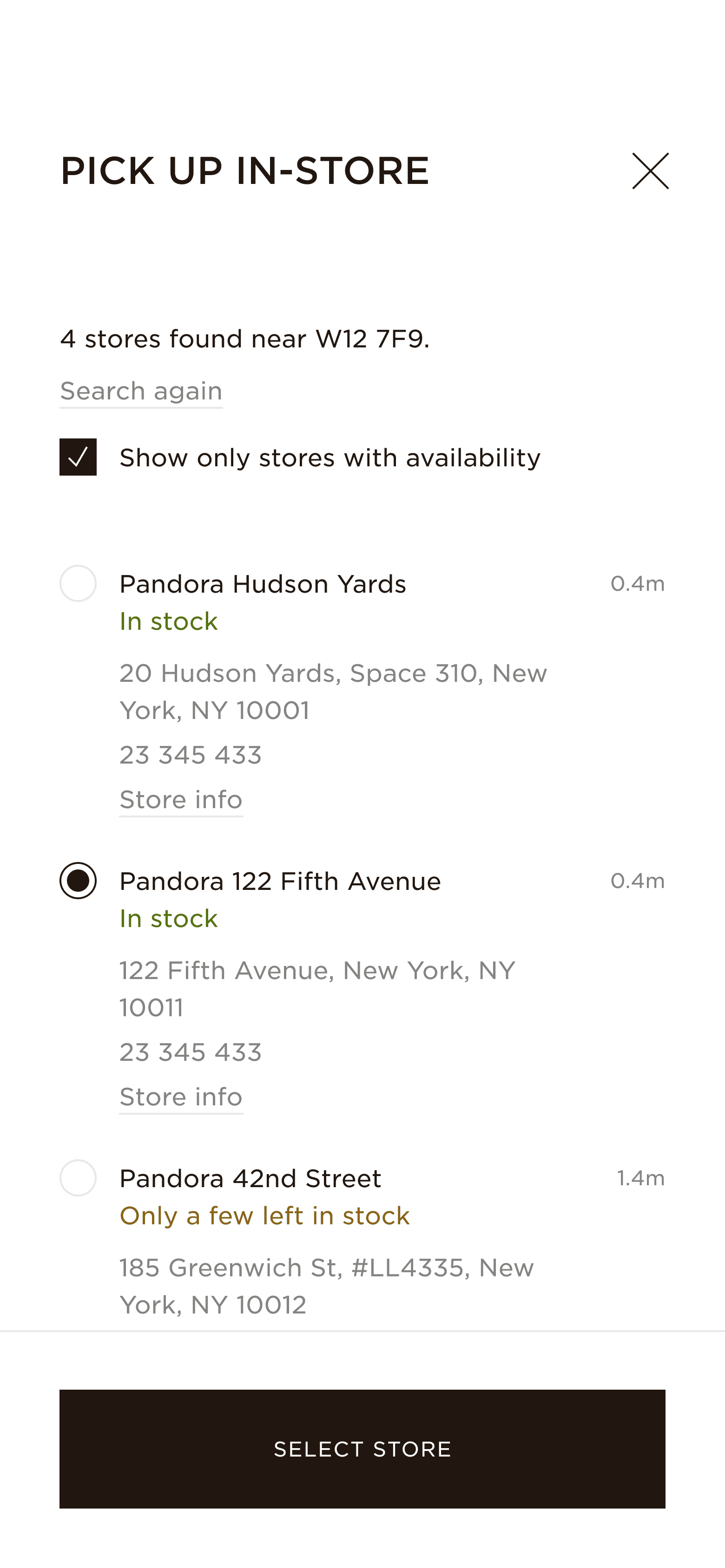
Click & Collect enhancement on PDP — store selector component with availability check, "select store" CTA, and persistent store memory across sessions
C&C store selector in Cart — the Cart Summary / Traffic Lights feature (launched UK, Jan 2026): shows per-item delivery availability inline in the bag, allowing customers to see and change their selected store without leaving the cart
PUDO flow from PDP — store lookup modal, location search by postcode or current location, store list with ETA and availability, slot confirmation
Delivery methods at Checkout Step 2 — redesigned delivery card for all 4 methods (Standard, Express, C&C, PUDO), with ETA component, fallback states, and method-switching logic
Split Shipment grouping UI — transparent grouping by fulfillment type, clear copy explaining separate arrivals, no-anxiety visual hierarchy
LATAM localisation — CPF validation field, store lookup adaptation, language toggle, country-specific fulfillment rules for Panama, Mexico, Chile, Peru, Brazil, Colombia, Argentina
Component anatomy documentation — Fulfillment Table: a structured spec covering all delivery method states, rules, and edge cases for the DS and dev teams
Market Adaptation
Localised variants for 7 LATAM markets — CPF validation (Brazil), C&C store lookup integration, language toggle logic — tested first in UK and Germany, then rolled out regionally. Each market required alignment with local commerce laws and fulfillment infrastructure.
0%
0%
C&C CVR uplift 36.11% → 43.56%
0%
0%
Cart drop-off 31.5% → 28.9%
0%
0%
Cart-to-checkout Gift packaging
0
0
LATAM markets Localised & shipped
Source: Adobe & EasyPost Analytics · UK market · C&C Cart Summary · Jan–Feb 2026. Weeks 6–7 showed the strongest SOB + SOO gains, confirming compounding impact as more users were exposed to the redesign.


Checkout Redefined: A/B Testing and Personalization at Scale
For the Pay module, the question wasn't "what should it look like" — it was "what changes move conversion." I owned the UX across the Cart-to-Checkout journey: gift packaging, Pandora Care warranty add-on, and the overall cart experience. Every design decision was tied to a hypothesis. Every hypothesis was tracked post-launch.
I led A/B experiments across five dimensions of the checkout funnel — designing test variants, coordinating hypothesis definition with PMs, and reviewing post-launch results to determine winner rollout.
What I designed in Pay
Gift packaging flow — selection UI, packaging preview, SKU eligibility logic, and confirmation state
Pandora Care opt-in component — warranty add-on with benefit explainer, inline upsell, and opt-out state
Cart experience enhancements — editable summary card, item-level quantity controls, delivery method display in bag, C&C store selector inline in cart
GWP / PWP modals — contextual upsell modals triggered by cart value, with product image, eligibility messaging, and CTA logic
Trust reassurance redesign — repositioned and redesigned the reassurance strip (returns policy, secure payment, free shipping threshold)
Step indicators — checkout breadcrumb redesign with clearer labels and progress state
Features Designed label
Gift packaging flow · Pandora Care opt-in · Cart summary redesign · GWP/PWP modals · Trust reassurance banner · Checkout step indicators · Editable summary card · Payment logo strip
Validating with Real Users: Research, Testing, & QA Support
To ensure our ideas resonated with real users, I partnered with the product and research teams to validate flows like PUDO, Gift Packaging, Pandora Cares, and Split Shipment. We used both moderated and unmoderated user tests in key markets (EU, LATAM), testing across devices and platforms. Insights from these sessions helped refine label clarity, icon meaning, step flow, and perceived trust. I also supported visual QA across devices and created test-ready Figma files for Maze and internal testing.
What Was Tested
Gift Packaging preference, C&C store discoverability, PUDO icon clarity, Split Shipment grouping, Checkout reassurance
Test Methods Used
Unmoderated Maze test, Moderated user calls, Figma click-throughs, visual QA review decks, dev-annotated flows
Business Impact & Measurable Outcomes
Every module shipped to production and was tracked post-launch via Adobe & EasyPost Analytics. These are the measured results across the three modules I owned.
0%
0%
C&C CVR uplift 36.11% → 43.56%
0%
0%
Cart drop-off Step 1, post-launch UK
0%
0%
Checkout completion Reassurance redesign
0
0
Cart-to-checkout Gift packaging placement
0
0
Gemini DS patterns Net-new, cross-team adopted
0+
0+
Countries live 3 languages
0%
0%
Cart-to-checkout Gift packaging
Adoption & Launches
Cart Summary / Traffic Lights — launched UK, 29 Jan 2026. CVR uplift confirmed within 3 weeks.
LATAM market live with CPF flow, GWP support, and 7-country localisation
Gemini components merged into core DS library — available to all Pandora design pods
Live rollout supported across 10+ countries and 3 languages
Contributions to Gemini Design System
Everything I designed had to live inside Gemini — Pandora's global design system — which meant every component needed to work across 20+ markets, in 3 languages, across mobile and web, and be extensible by other designers without rework. I didn't just use the system; I grew it.
I introduced 14 net-new reusable patterns into Gemini. These aren't one-off designs — they're documented components with anatomy specs, usage rules, state coverage, and dev handoff notes. Other pods adopted them directly, reducing delivery effort and eliminating redundant patterns across the checkout experience.
New Components Designed
Delivery Card (PUDO, C&C)
Packshot Cycle Preview Block
Gift Packaging Selection Modal
Trust Reassurance Banner
Checkout Step Labels (Breadcrumbs)
Collaboration Points
Weekly syncs with Gemini Core Team — naming conventions, usage rules, token alignment
Design tokens mapped to brand variants for market-specific colour and spacing overrides
Component anatomy documentation (Fulfillment Table) — structure, states, rules, and edge cases handed off to dev and QA
Dev/QA handoff notes for every component, including annotated Figma flows and spec pages
Personalization
Customizable settings allow users to tailor scheduling preferences and priorities to their unique needs.
Retrospective & What’s Next
What I'd do differently: I'd push for accessibility audits at the component design stage, not post-launch. Several WCAG AA gaps in the Delivery module were caught late in QA — avoidable with Stark integrated earlier in the workflow. I'd also advocate for a shared LATAM UX brief earlier in the project; market-specific constraints (CPF, store networks, fulfillment laws) were sometimes discovered mid-design, adding rework cycles that structured discovery would have prevented.
What I'd do the same: Lead with system thinking from day one. Every decision in the Delivery module was made with Gemini in mind — which is why 14 new patterns were adopted by other pods without refactoring. Designing components with their DS lifecycle in mind, not just the immediate screen, is the thing I'd never give up.
What launched: Cart Summary / Traffic Lights is live in the UK as of January 2026, with store-change-in-bag functionality already shipped. Next up: wishlist-first checkout and predictive fulfillment.
On Systems
Design systems only work if they evolve with the product. Contribution, not just consumption, is the designer's responsibility.
On A/B testing
Test clarity depends on copy and visual priority as much as layout. A winning variant is defined before launch, not discovered after.
On Localisation
Localisation isn't translation — it's UX logic. CPF validation, store network constraints, and fulfillment laws require design decisions, not just copy swaps.